EURO-3C: what the launch means for the IPCEI-CIS community
17, March, 2026
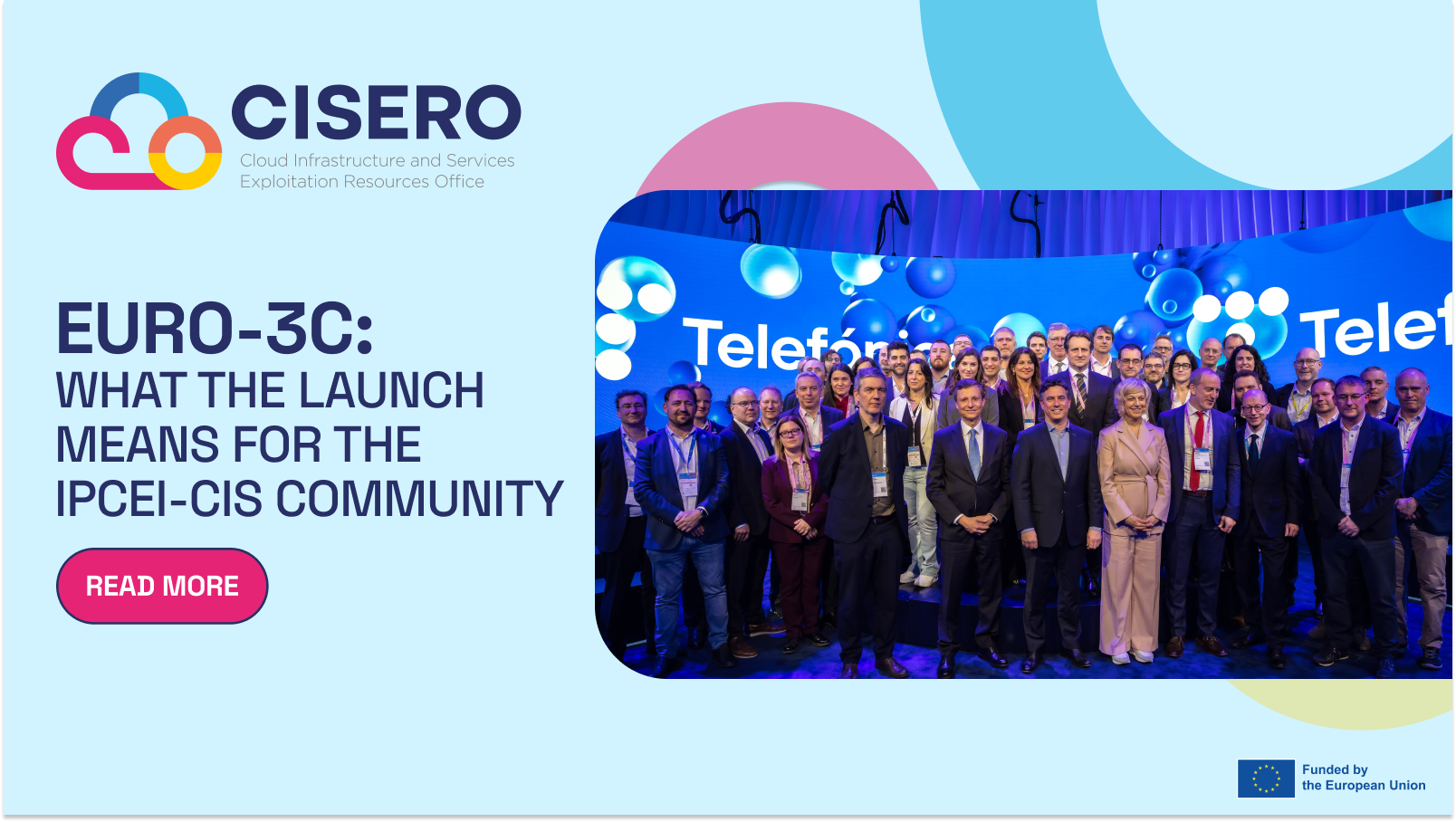
At the recent MWC26, the EURO-3C project was publicly announced by the European Commission and a consortium led by Telefónica. It is the first pan-European sovereign digital infrastructure integrating Telco, Edge, Cloud and AI, operating under a federated, open and secure model. The announcement marks a landmark moment for Europe's digital and industrial transformation. With over 70 nodes across 13 countries and a consortium of more than 70 organisations — operators, vendors, SMEs, research centres and public authorities — the project translates the community's core objectives into a working, federated infrastructure.
EURO-3C is another step forward toward the objectives of the European Union's Digital Decade Policy Programme 2030, which places secure and sustainable digital infrastructures as one of its strategic pillars. EURO-3C delivers the execution layer, making possible interoperable services running across multiple operators and cloud providers under a common European framework, enhanced with AI-driven orchestration and built to the security standards that critical sectors demand. Nine validated use cases — spanning automotive, energy, transport and public safety — demonstrate that the architecture works beyond controlled environments.
The consortium spans telecoms operators, cloud providers, technology manufacturers, SMEs, universities and research centres, reflecting the broad cross-sector collaboration at the heart of the project.
Telefónica · Eurescom · British Telecom · Capgemini · Citymesh · Deutsche Telekom · Elisa · Engineering · Ericsson · Ionos · IDC · KPN · MEO · Nokia · Orange · OVH · Suse · Swisscom · Fastweb · Telenor · TIM · Thales · Vodafone · Fogus · Krateo · Martel · Nearby · Nextworks · OpenNebula · Real Wireless · Scille · Sedicii · Ubitech · Wings · CTTC · F. Bruno Kessler · Fraunhofer · IMEC · INRIA · ITAV · POLITO · PCSS · TNO · UC3M · UOULU · ECSO · ETSI · PSCE · AIT · Bavarian Red Cross · ITTI · Frequentis · Meditech · Stellantis · Teltronic · Electricite de France · Harman · CAF · Multiverse Computing · OGRE
Thirteen national public safety and civil protection authorities across Europe are affiliated with the project through PSCE, embedding sovereign governance and operational requirements directly into the consortium.
- Erillisverkot — Finland
- Ministry of Citizen Protection — Greece
- National Agency for Communication and Information Technologies — Czechia
- Ministerio del Interior — Spain
- Agency for Operational Mobile Communications for Security and Emergency Response — France
- Department of Public Expenditure, NDP Delivery and Reform — Ireland
- Netherlands Police — The Netherlands
- Norwegian Directorate for Civil Protection — Norway
- National Police Directorate — Norway
- Ministry of the Interior and Administration — Poland
- Special Telecommunications Service — Romania
- Swedish Civil Defence and Resilience Agency — Sweden
- Swedish Police Authority — Sweden
For the IPCEI-CIS community, EURO-3C represents the clearest signal yet that the convergence infrastructure Europe has been designing is ready to scale.